Shuttle bus
Car park
Handicap access
Restaurant
Internet access
Air conditioning
Spa
Swimming pool
Sports equipment
Animals allowed
Family
International Standard
Well located
Gastronomy
Charm
Our pickThe Lutetia is nothing less than a historical, cultural and aesthetic institution, or at least that's what you'll hear from Parisians. This magnificent Art Deco building that dates from the beginning of the 20th Century is of immense historical value, as it served as the headquarters of the German forces during WWII, before becoming a centre that sheltered and searched for Jews who'd survived the concentration camps. Its cultural importance stems from its Left Bank location, an area known for its active literary scene and jazz concerts. The building's aesthetic value is derived from its magnificent Art Deco architecture; it was built in 1907 and is now listed as a historical monument, and everyone who walks past it is amazed by its beautiful 'Belle Epoque' arches and its carefree style typical of the Roaring 20s.
The hotel stands at the intersection of boulevard Raspail and rue de Sèvres, at the heart of the elegant sixth arrondissement of Paris. Located opposite metro lines 12 and 10, it's a 6-minute walk away from Saint-Germain-des-Prés. In only three stops and one metro line change, you can get to the RER line B, which will take you to the Charles-de-Gaulle or Orly airport. A 10-minute stroll will take you to the Seine or the Louvre. As for shopping, the Bon Marché is just in front of the hotel, and Rue de Rennes in not far away either.
In 2010, the Lutetia celebrated its first centenary, as it was inaugurated in 1910. The 100th anniversary is the main theme of this ancient hotel, and in 2010 there were many events put on in its honour.
On Sundays, both restaurants, the gastronomic restaurant and the standard one, are open to the public and serve a copious brunch. This one of the favourite Sunday activities for Parisians on the Left Bank.
The façade that holds pride of place on the Sèvres-Babylone intersection is the perfect introduction to the hotel: it boasts a splendid Art Deco style, and you'll wander into the Lutetia with your eyes wide open so as to take in every detail. Once past the elegant revolving door (manually operated, made of wood), you can hand your car keys to the parking valet and your luggage to the bellboy, before admiring the splendid setting of the entrance hall. Its checkered look will make you feel like a pawn moving through the history of the Lutetia, over the black and white marble and among the intricate woodwork of the reception desk and the concierge (discretely concealed on the side, as is standard practice). The hotel has high ceilings and is bathed in a quaint and yet classic atmosphere (typically Parisian one might say). It also features many works of art that highlight the historical blend of a grand hotel on the Left Bank and the artistic tradition of Saint-Germain-des-Prés.
The Lutetia was built as a hotel between 1907 and 1910 and it has managed to retain the opulence of the Belle Epoque style, with influences of the carefree Roaring 20s and a highly modern level of comfort. The entrance to the main lounge features an elegant lamppost-statue and the room itself has a hushed atmosphere (a consequence of being badly lit maybe), with a large stained glass bay window, which is now listed as a historical monument. The central theme of the hotel is that it's crammed with details of great historical and aesthetic interest that place the establishment in the context of Parisian, and even French History. This is illustrated by the wooden 'cash register' of the reception area, which is resolutely old-fashioned and purely decorative, and cannot be removed as it's now part of the cultural heritage of that era.
Thanks to its elegance and a certain penchant for luxury, the Lutetia is considered by many to be the 'palace' of the Left Bank. Although it doesn't have the fifth star to officially bear that title (and has no intention of acquiring it either), the fact that it is dubbed a palace speaks volumes for its standing in this famous city.
The rooms of the Lutetia have a special atmosphere. They all boast a rather quaint style, but with a tasteful blend of more modern influences and a very high level of comfort. The rooms follow the general style of the hotel, although each different category comes with its own specific features.
The first categories, deluxe and superior, are very comfortable. They're around 30 m², with a large king size bed, and a nicely designed bathroom that goes well with the general setting. They also include cushy wall-to-wall carpeting and high windows.
Then there are the 'classic' rooms and theme suites. The latter are highly evocative and try hard to live up to the name that they were given (which is sometimes a little too poetic). Among others, there is the 'Literary' suite, the 'Bear' suite, the 'Polar bear' suite and the 'Eiffel' suite.
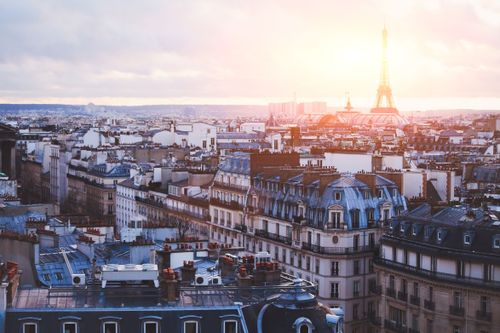
The latter is located on the seventh floor (711) and includes, naturally, a bedroom and a sitting room. It also boasts a view of the Eiffel Tower, which you can enjoy from the small round bedroom balcony. The setting is highly romantic.
The Arman suite may not be the most frequented of the hotel, but it's definitely the establishment's nicest gem. It is highly representative of the district's atmosphere and its former artistic life, and it was entirely designed and decorated by Arman, the famous French sculptor after whom it was named. It covers an area of 150m² and is the result of what the themes 'Africa' and 'Music' evoked in the artist's imagination. With remarkable foresight, the Arman suite follows the current Museum-Hotel trend and features numerous works of art, be it the cello-shaped armchair or the sculptures in the bedroom watching over sleeping guests.
The Lutetia has two restaurants and one breakfast room for hotel guests. The two restaurants are well known in the capital and are open to hotel guests and residents of the area alike, most of whom are frequent patrons as the establishment provides a perfect place to have a bite to eat after a shopping session at the Bon Marché (especially the brasserie).
The gastronomic restaurant, Le Paris, has been run for the past 12 years by chef Philippe Renard, who's won several Michelin stars. The hotel's management is proud of details such as this, as they highlight the feeling of 'belonging' and 'tradition' that characterises this establishment, which many consider to be the palace of the Left Bank.
The Lutetia is a typical brasserie, and is run by the same chef as the gastronomic restaurant. The focus is therefore on French cuisine and the dishes are prepared with the utmost care, and even the simplest 'chicken and mash' becomes the most elaborate dish. The fries are homemade, as is the mash, and some of the herbs can boast having been grown under the sun of the Provence region. Furthermore, the Lutetia has a proud tradition when it comes to fish, which comes in fresh directly from the Atlantic coast. The fish and the oysters are delicious. Not forgetting the desserts: from the most standard to the most original, such as the green tea cake, most are served as small helpings, which are much appreciated as they enable you taste just the right amount.
The hotel's guests can enjoy their breakfast in of one of the rooms that opens onto Boulevard Raspail. A high ceiling and heavy drapes set the tone for the room. The menu includes an American style breakfast with salty and sweet specialties. Finally, also worthy of mention: there are several types of milk on offer (goat's milk, cow's milk and mare's milk, as well as a few organic products.
Finally, the Le Paris restaurant serves a luxury breakfast: nothing but home made products prepared by the pastry chef.
Hotel reviews based on comfort, location and price ratings of its categories
Hotel reviews based on its services and facilities.
Mark out of 10 for geographical location